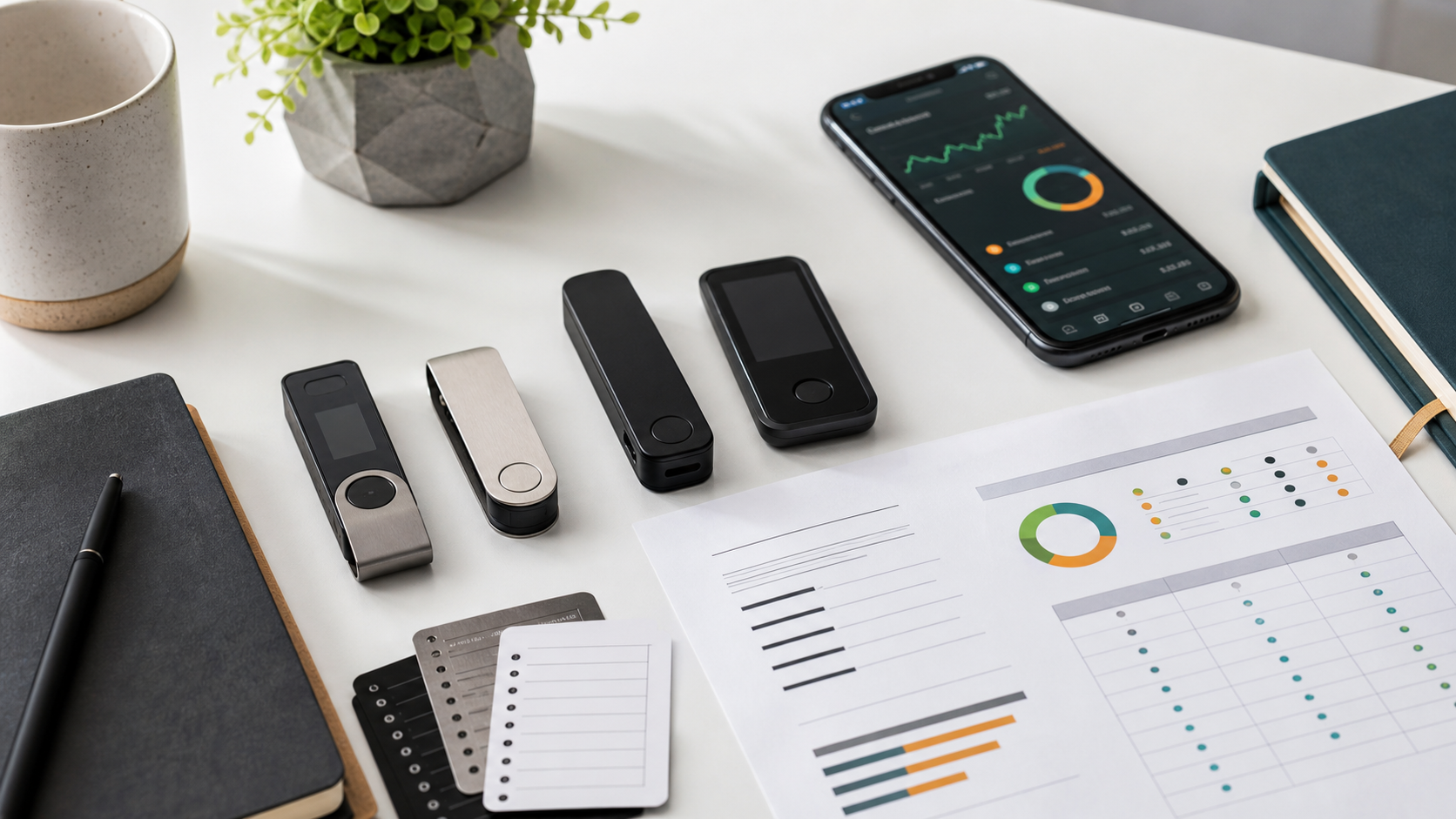
Best Web3 Hardware Wallets in 2026: CMS Draft Based on Supplied Ledger Data
This article compares only the wallet records supplied in the job context: Ledger Titan 2.0, Ledger X Card, and Ledger Hardware Wallet Line. The source material is primarily official Ledger homepage capture data in several language versions, plus product fields in the CMS wallet records. Because the source capture is mostly a Ledger homepage rather than complete per-model product pages, this article uses cautious wording and includes evidence checkpoints throughout.
The most important limitation is scope. This is not a market-wide ranking of every hardware wallet available in 2026. It is a constrained best-of draft built from the supplied data. Within that dataset, the strongest beginner and card-wallet fit signal is Ledger X Card. The strongest large-portfolio fit signal is Ledger Titan 2.0. The broader Ledger Hardware Wallet Line is useful for context, but it needs more verification before it can be treated as a detailed model-level recommendation.
Best Web3 Hardware Wallets in 2026: Quick Picks
| Rank | Wallet | Best For | Price | Our Draft Score |
|---|---|---|---|---|
| 1 | Ledger X Card | Beginners and card-wallet users, based on supplied fit fields | Not supplied | 4.25 / 5 |
| 2 | Ledger Titan 2.0 | Large portfolios and air-gapped QR signing, based on supplied wallet data | $150-$200 | 3.50 / 5 |
| 3 | Ledger Hardware Wallet Line | Broader Ledger ecosystem context requiring verification | Not supplied | Not scored |
How the article score was calculated: For wallets with supplied fit fields, the article score is the simple average of beginnerFit, seniorFit, largePortfolioFit, and cardWalletFit. Ledger X Card has supplied values of 5, 4, 3, and 5, producing 4.25. Ledger Titan 2.0 has supplied values of 4, 3, 5, and 2, producing 3.50. Ledger Hardware Wallet Line has no supplied fit values, so it is not scored.
How We Chose
This article ranks the supplied wallets by the structured CMS fields available in the job context. We prioritized scenario fit signals, signing workflow, connectivity, app support, supplied asset-support fields, and whether pricing was supplied. We did not invent missing prices, model-level chip certifications, release years, open-source status, or unsupported connection details from the source captures.
The supplied official Ledger source materials support broad Ledger ecosystem claims: Ledger presents itself as a crypto wallet and security provider for DeFi and Web3; describes Ledger Wallet as a crypto wallet app and Web3 gateway; says Ledger Wallet 4.0 supports actions such as buying, swapping, staking, spending, or building a portfolio; and states that hardware wallets store private keys offline. The same source materials also include limitations: they do not provide complete per-model pricing, connection specifications, open-source status, or release years.
For that reason, the ranking below is deliberately conservative. It reflects only the data provided, not a full independent lab test.
Ledger X Card — Best Overall for Beginners and Card-Wallet Users
Based on the supplied fit fields, Ledger X Card is the top-ranked option in this limited dataset. It has the highest average draft score because it receives a beginnerFit of 5, seniorFit of 4, largePortfolioFit of 3, and cardWalletFit of 5. That makes it the strongest supplied match for users who want a card-style hardware wallet experience and a mobile-first workflow.
The supplied product data lists Ledger X Card as an NFC card hardware wallet with NFC card signing, mobile app support, seed phrase backup, and a Secure Element chip note. It also lists support fields for Bitcoin, XRP, Solana, EVM, WalletConnect, NFTs, staking, and swaps. The supplied supportedAssets field contains “15,000+ crypto assets” with examples including Bitcoin, Ethereum, Solana, XRP, and stablecoins.
This makes Ledger X Card the cleanest fit for the target user who values portability and card-wallet convenience. However, several details need verification before publication. The supplied price band is not available, and the official source capture limitations repeatedly warn that prices should not be inferred from the captured homepage. If this article becomes a public article, editors should confirm the current product page, availability, exact price, regional restrictions, and setup workflow.
Pros based on supplied data:
- Highest supplied beginnerFit score: 5.
- Highest supplied cardWalletFit score: 5.
- NFC and mobile-app workflow are supplied in the wallet record.
- Supplied data lists broad asset examples, including Bitcoin, Ethereum, Solana, XRP, and stablecoins.
Cons and verification needs:
- No supplied price band.
- The official source captures do not independently verify model-level NFC details.
- The article should not infer release year, open-source status, or certification level.
Best for: Users who specifically want a card-style, mobile-supported hardware wallet workflow and are comfortable verifying current product details before purchase.
Ledger Titan 2.0 — Best Runner-Up for Large Portfolios and Air-Gapped QR Signing
Ledger Titan 2.0 ranks second overall in this constrained dataset, but it is the strongest supplied option for large portfolios. The supplied fit fields give it a largePortfolioFit of 5, beginnerFit of 4, seniorFit of 3, and cardWalletFit of 2. Its average draft score is 3.50, lower than Ledger X Card, but its large-portfolio score is the highest available.
The supplied wallet record describes Ledger Titan 2.0 as an air-gapped touchscreen hardware wallet using an air-gapped QR signing workflow. It lists airGappedSupport as true, qrSigningSupport as true, mobileAppSupport as true, and usbSupport, bluetoothSupport, and nfcSupport as false. Its supplied recovery model is seed phrase backup, and the security notes field says Secure Element chip.
The supplied price band is $150-$200, which makes it the only wallet in this dataset with a stated price range. Editors should still verify that range before publication because pricing can change, and the official Ledger source captures do not provide visible product prices.
This wallet’s value proposition, as supplied, is separation from direct cable, Bluetooth, or NFC connections and a QR-based signing flow. That can be attractive for users who prefer a more visibly isolated transaction workflow. However, the article should not overstate this into a guarantee. Air-gapped signing can reduce some connectivity exposure, but users still need to verify transaction details, protect recovery phrases, avoid malicious apps or dApps, and maintain secure backups.
Pros based on supplied data:
- Highest supplied largePortfolioFit score: 5.
- Supplied air-gapped QR signing workflow.
- Supplied touchscreen hardware wallet product family.
- Supplied price band: $150-$200.
- Supplied support fields include WalletConnect, NFTs, staking, swaps, Bitcoin, Solana, XRP, and EVM.
Cons and verification needs:
- Lower cardWalletFit score than Ledger X Card.
- SeniorFit is 3, so it may not be the simplest choice for every user.
- Official source captures do not provide complete per-model details for this record.
Best for: Users with larger portfolios who value an air-gapped QR signing workflow and are willing to confirm current product documentation before relying on it.
Ledger Hardware Wallet Line — Also Worth Considering, but Needs Model-Level Verification
The Ledger Hardware Wallet Line record is useful as a broader ecosystem entry, but it should not be treated as a fully scored individual wallet. The supplied wallet record lists a product family description referencing a global hardware wallet brand, Bluetooth + USB, and EAL5+ in Chinese-language metadata. However, the source synthesis brief explicitly warns not to use registry notes such as Bluetooth + USB or EAL5+ as extracted evidence when those details are not present in the visible captured text.
The official Ledger source captures do support several broader claims. Ledger lists device lines including Ledger Stax, Ledger Flex, Ledger Nano Gen5, and Ledger Nano Classics. It describes Ledger Wallet as a crypto wallet app and Web3 gateway. It says users can manage 15,000+ crypto assets, including examples such as Bitcoin, Ethereum, Solana, XRP, and stablecoins. It also says users can diversify across more than 90 chains and compare prices across more than 50 service providers in the app context.
The source also supplies screen-size claims for the named Ledger lines: Ledger Stax is described with a 3.7-inch curved screen; Ledger Flex with a 2.8-inch Gorilla Glass screen or display; Ledger Nano Gen5 with a 2.8-inch lightweight, slim, or light screen; and Ledger Nano Classics with a 1.1-inch screen.
Because the structured wallet record lacks beginnerFit, seniorFit, largePortfolioFit, and cardWalletFit, this entry remains unscored. It is best used as a prompt for editors to add product-specific pages and updated facts.
Best for: Editorial context and internal CMS expansion, not a final public recommendation until model-level specs are verified.
What to Look for When Choosing a Web3 Hardware Wallet in 2026
For Web3 users, the best hardware wallet is not simply the one with the longest asset list. The right choice depends on how you sign transactions, which apps you use, how you back up recovery material, and how comfortable you are verifying on-device prompts.
Signing workflow is the first decision point. The supplied Ledger Titan 2.0 record emphasizes air-gapped QR signing. That may appeal to users who want a workflow where transaction data is passed visually rather than through USB, Bluetooth, or NFC. The supplied Ledger X Card record emphasizes NFC card signing, which may be more convenient for phone-first users. Convenience and isolation are both valuable, but they solve different problems.
Recovery model is equally important. The supplied records list seed phrase backup. That means the recovery phrase remains the critical failure point. Ledger’s own captured official pages warn that Ledger will never ask for the 24 words of a recovery phrase and that users should never share them. This warning should be carried into any final article because phishing is one of the most realistic risks for hardware wallet users.
Asset and app support should be verified against what the user actually holds. The supplied Ledger source materials say users can manage more than 15,000 crypto assets and name Bitcoin, Ethereum, Solana, XRP, and stablecoins as examples. The app context also includes claims about buying, swapping, staking, spending, diversification across more than 90 chains, and comparison across more than 50 service providers. These are broad ecosystem claims; editors should verify whether each individual wallet supports the exact assets and workflows a reader needs.
Security wording needs careful handling. A hardware wallet can keep private keys offline, and the Ledger FAQ material says hardware wallets store private keys offline and provide control and increased security. But no draft should imply that a wallet makes users immune to malicious smart contracts, phishing, address poisoning, fake apps, compromised computers, or recovery phrase loss.
Our Final Verdict
Within the supplied dataset, Ledger X Card is the best overall draft pick for a Web3 hardware wallet because it has the highest calculated fit score and the strongest beginner and card-wallet signals. Choose it in this article if the target reader wants a phone-friendly, NFC-style card wallet and if editors can verify the current product page before publishing.
Ledger Titan 2.0 is the better draft pick for users who care most about large-portfolio fit and an air-gapped QR signing workflow. It is also the only supplied wallet record with a price band, $150-$200, though that should still be verified.
The Ledger Hardware Wallet Line should remain an “also worth considering” entry until the CMS has model-level facts, prices, connection details, and review evidence. The supplied Ledger sources support broad claims about Ledger Wallet, asset examples, offline private-key storage, and device screen descriptions, but they do not support all specs needed for a final buyer’s guide.
Frequently Asked Questions
Is this a complete best hardware wallets 2026 ranking?
No. This is a best-of article based only on the supplied wallet data and source materials. It should not be presented as a complete market-wide ranking unless additional wallet brands, review evidence, and scoring data are added.
Which supplied wallet is best for beginners?
Based on the supplied fit fields, Ledger X Card is the strongest beginner option because it has a beginnerFit score of 5. That is a CMS data signal, not an independent usability test.
Which supplied wallet is best for larger portfolios?
Ledger Titan 2.0 has the highest supplied largePortfolioFit score at 5. The article treats it as the large-portfolio pick because the supplied data also lists an air-gapped QR signing workflow.
Can the article say Ledger has zero hacks?
Only with careful attribution, and preferably as a verification note rather than a verdict. The supplied official pages include “0 Hacks” or translated equivalents, but the source brief explicitly warns not to present that as independently audited or universally verified.
What should editors verify before publishing?
Verify product names, brand alignment, current prices, purchase URLs, exact connection methods, chip and certification details, supported assets, app compatibility, recovery workflow, and whether any official security claim has independent corroboration.