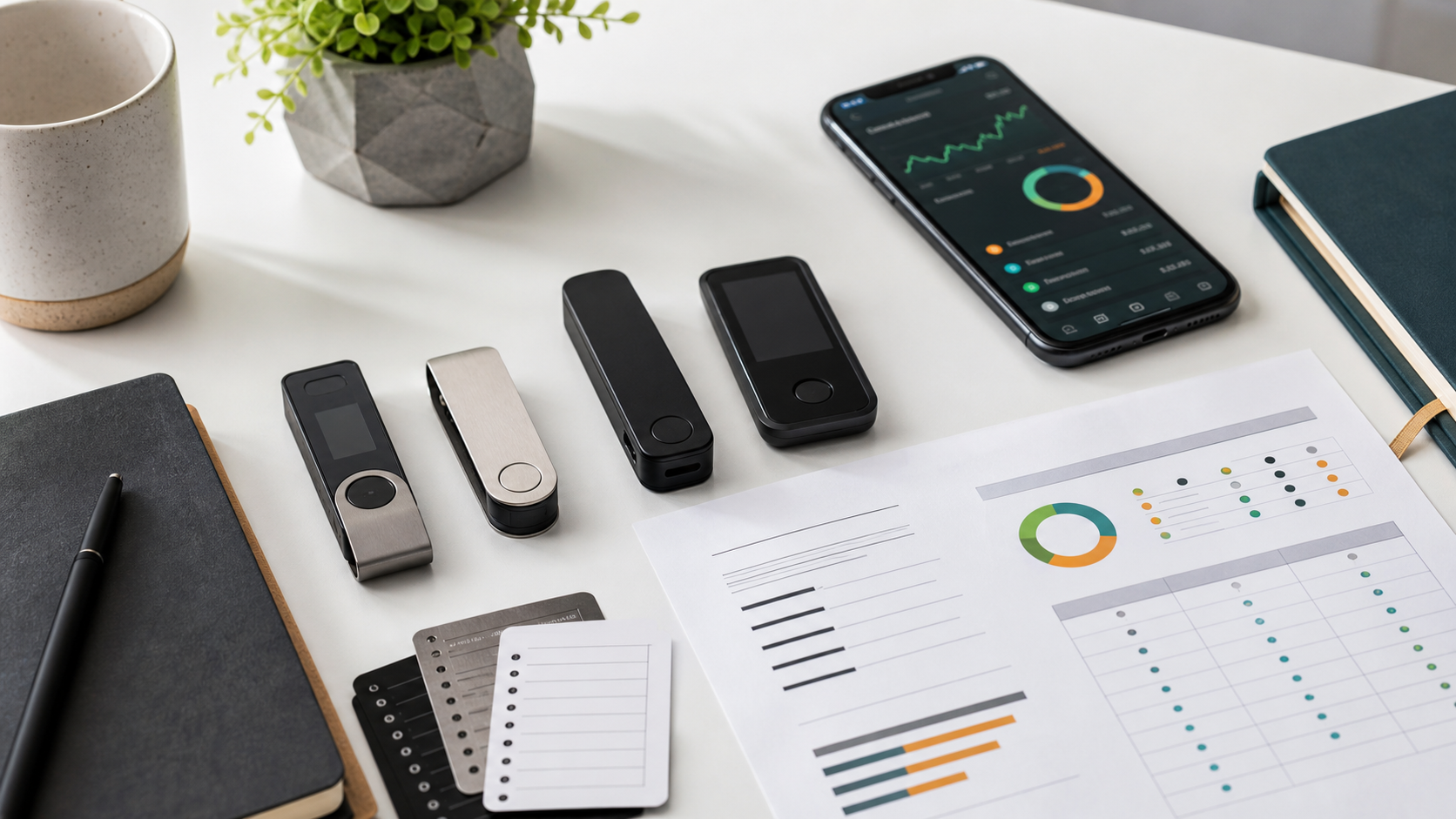
ELLIPAL Titan 2.0 vs Ledger Hardware Wallet Line: The Quick Answer
If your priority is minimizing cable and radio interfaces in the supplied dataset, ELLIPAL Titan 2.0 has the clearer security-architecture fit: it is listed as an air-gapped touchscreen hardware wallet using an air-gapped QR signing workflow, with no NFC, Bluetooth, USB, or desktop app support recorded. If your priority is flexible day-to-day connectivity, Ledger Hardware Wallet Line has the clearer convenience fit because the supplied product data lists Bluetooth, USB, and mobile app connectivity, while Ledger’s official site describes the Ledger Wallet app as a crypto wallet app and Web3 gateway.
This article does not declare an overall winner. The data supports category-level distinctions only.
Full Comparison Table
| Dimension | ELLIPAL Titan 2.0 | Ledger Hardware Wallet Line | Evidence checkpoint |
|---|---|---|---|
| Connection type | Air-gapped QR signing workflow | Bluetooth, USB, mobile app | ELLIPAL and Ledger Wallet Product Data |
| Wireless exposure | No Bluetooth or NFC recorded; QR workflow | Bluetooth recorded; NFC not recorded in product data | Verify model-specific Ledger details before publishing |
| Secure chip | Secure-element details require verification | Product family text mentions EAL5+, but notes say verify current certification | Do not publish certification claims as verified without new evidence |
| Screen | Touchscreen hardware wallet product family | Source pages list multiple Ledger devices with different screen references, but line-level product data does not normalize one screen | Avoid a single Ledger screen spec for the whole line |
| Coins supported | Supplied product data lists BTC, ETH, XRP, SOL, EVM | Normalized supportedAssets field is empty; Ledger pages include attributed marketing claims about broad support | Keep Ledger asset breadth attributed to Ledger site only |
| Price | Price band supplied: $150-$200 | Not supplied in Wallet Product Data | Do not invent Ledger price |
| Open source | Not supplied | Not supplied | Verification needed |
| Battery | Not supplied | Not supplied | Verification needed |
| Setup difficulty | Beginner fit score 4; senior fit score 3 in supplied product data | Not supplied | Scores are internal product-data fit indicators, not independent test results |
| Security record | No security incident record supplied | Ledger pages include marketing/security statements and phishing warnings | Do not claim either is hack-proof or independently safer |
Security Showdown
The most important difference in the supplied data is the signing and connection architecture.
ELLIPAL Titan 2.0 is described in Wallet Product Data as an air-gapped touchscreen hardware wallet using an air-gapped QR signing workflow. In the same dataset, air-gapped support and QR signing support are marked true, while NFC, Bluetooth, USB, and desktop app support are marked false. In plain language, an air-gapped QR workflow means the wallet is designed to sign through a visual code exchange rather than through a direct USB cable, Bluetooth session, or NFC tap recorded in this dataset. The transaction process usually creates a separation between the device holding keys and the internet-connected phone environment, but this article cannot claim that the setup eliminates all risk.
Ledger Hardware Wallet Line is represented in Wallet Product Data with Bluetooth, USB, and mobile app connectivity. That gives Ledger a different security/convenience tradeoff: more connection options may reduce daily friction, but each supported interface must be evaluated carefully in the context of the exact Ledger model, firmware, app workflow, and user behavior. The supplied job context does not provide a model-by-model security specification table, so this article should not collapse the entire Ledger line into one uniform device architecture.
The supplied Ledger source pages support general educational points about private keys and wallet security. Ledger’s official site explains that wallets involve public and private keys, that private keys should be kept secret, and that hot wallets are connected to the internet and more exposed to online attacks than cold or hardware wallets. The English Ledger source is preserved here: https://www.ledger.com/. The French and German variants provide similar official-page corroboration: https://www.ledger.com/fr and https://www.ledger.com/de.
The source brief also flags caution around secure elements and certifications. ELLIPAL Titan 2.0 secure-element notes say: “Official ELLIPAL product; verify current secure-element details before publishing.” Ledger product data includes positioning language mentioning EAL5+, but the secure-element notes also say to verify the current certification before publishing. Therefore, the responsible draft wording is: secure-chip and certification details need editorial verification for both sides before publication.
Recovery-phrase security is another shared caution. ELLIPAL Titan 2.0 uses a seed phrase backup according to product data. Ledger’s official pages warn that Ledger will never ask for the 24 words of a recovery phrase and that users should never share them. That warning is source-supported by Ledger’s official pages, including https://www.ledger.com/. The principle applies broadly: whichever wallet a user chooses, the seed phrase remains a critical point of failure if photographed, typed into a fake website, stored in cloud notes, or shared with a scammer.
Ease of Use
Ease of use depends on what the user considers “easy.” For some people, fewer connectivity options and a dedicated screen feel reassuring. For others, phone pairing, Bluetooth, USB, and a broad app ecosystem feel simpler.
ELLIPAL Titan 2.0 is listed as a touchscreen hardware wallet with mobile app support and an air-gapped QR signing workflow. That suggests a user experience centered on scanning QR codes between the hardware wallet and the mobile app. The practical benefit is that the workflow is visible and deliberate: users should expect to review transaction details on a dedicated device and complete signing through QR exchange. The practical friction is also clear: QR signing can involve more steps than a direct cable or wireless flow, and users need to be comfortable checking addresses, networks, and transaction prompts carefully.
The supplied fit scores give ELLIPAL Titan 2.0 a beginner fit of 4, senior fit of 3, large portfolio fit of 5, and card wallet fit of 2. These are useful internal product-data indicators, but they should not be presented as independent user testing. They point toward a wallet that may be especially relevant for people managing larger portfolios and wanting an air-gapped workflow, while not being positioned as a card-wallet replacement.
Ledger Hardware Wallet Line is represented with Bluetooth, USB, and mobile app support in Wallet Product Data. Ledger’s official site describes Ledger Wallet as a crypto wallet app and Web3 gateway with functionality around buying, swapping, staking, spending, portfolio management, and dApp/Web3 access. That source is Ledger’s own site, so the phrasing should remain attributed and cautious: Ledger says its ecosystem supports these app experiences, but availability can depend on the device, region, asset, third-party provider, and current app support. Citation: https://www.ledger.com/.
For ease of use, then, the category split is straightforward. ELLIPAL Titan 2.0 appears stronger for users who prefer a deliberate QR-based signing routine and want the supplied dataset’s no-Bluetooth/no-USB posture. Ledger appears stronger for users who prioritize flexible connection methods and a broader app gateway described by Ledger’s official materials. Neither approach is universally easier; the better workflow depends on whether the user values reduced interfaces or lower daily transaction friction.
Asset Support and Compatibility
Asset support is one of the areas where the supplied data requires extra caution.
For ELLIPAL Titan 2.0, Wallet Product Data lists supported assets or asset categories as BTC, ETH, XRP, SOL, and EVM. The same product data marks bitcoinSupport, xrpSupport, solanaSupport, evmSupport, walletConnectSupport, nftSupport, and stakingSwapSupport as true. The article can state those points as supplied product-data facts, but editors should still verify current asset lists before publication because wallet support can change over time.
For Ledger Hardware Wallet Line, the normalized supportedAssets field in Wallet Product Data is an empty array. That means this article should not fill a Ledger product-data asset list with BTC, ETH, XRP, SOL, or EVM based on inference. However, the supplied Ledger official pages include marketing statements about broad crypto support, including references to managing 15,000+ crypto, 90+ chains, and 50+ service providers. The source synthesis brief explicitly says these may be used only as attributed Ledger-site marketing claims and not as independent verification or ranking. Citation: https://www.ledger.com/.
Compatibility also differs by app environment. ELLIPAL Titan 2.0 is listed with mobile app support and no desktop app support. Ledger Hardware Wallet Line is listed with mobile app support; desktop app support is false in the supplied Wallet Product Data, even though Ledger’s broader ecosystem language appears on its site. Do not infer desktop compatibility for this comparison unless updated product data or official model-specific evidence is added.
Price vs Value
Only one clear price band is supplied. ELLIPAL Titan 2.0 has a price band of $150-$200 in Wallet Product Data. Ledger Hardware Wallet Line has no supplied price band in the normalized product data for this job context. That prevents a precise dollar-for-dollar value verdict.
The better value depends on what the user is buying for. Titan 2.0’s value proposition in this article is its supplied architecture: air-gapped QR signing, touchscreen product family, mobile app support, seed phrase backup, and no Bluetooth, NFC, USB, or desktop app support recorded. Users who specifically want that combination may find the listed price band easier to evaluate because it is present in the dataset.
Ledger’s value proposition, based on supplied data and official Ledger source summaries, is ecosystem flexibility: Bluetooth and USB in product data, mobile app support, and Ledger Wallet positioning as an app/Web3 gateway on Ledger’s site. Ledger’s official pages also list device families such as Ledger Stax, Ledger Flex, Ledger Nano Gen5, and Ledger Nano Classics, but the supplied context does not provide model-level prices or full specifications for each device. Citation: https://www.ledger.com/.
Therefore, this article should not say one is better value overall. It can say Titan 2.0 has the only supplied price band, while Ledger requires model-specific price verification.
Who Should Choose ELLIPAL Titan 2.0
ELLIPAL Titan 2.0 is the more natural shortlist candidate for users who want an air-gapped QR signing workflow based on the supplied dataset. It suits people who are comfortable using a mobile app while keeping the hardware wallet’s signing workflow separate from Bluetooth, NFC, and USB connections as recorded in the product data.
It may also suit users who want a touchscreen hardware wallet and who hold assets or asset categories specifically listed in the supplied ELLIPAL data: BTC, ETH, XRP, SOL, and EVM. Its largePortfolioFit score is 5, which may indicate internal positioning toward larger holdings, though that should not be treated as an independent security rating.
Choose this direction if your preference is deliberate transaction review, QR-code signing, and fewer connection interfaces in the supplied product profile. Before buying or publishing a recommendation, verify current secure-element details, current asset support, firmware process, app support, and exact pricing.
Who Should Choose Ledger Hardware Wallet Line
Ledger Hardware Wallet Line is the more natural shortlist candidate for users who want flexible connectivity and an app ecosystem described by Ledger’s own site. The supplied product data lists Bluetooth, USB, and mobile app connectivity. Ledger’s official site presents Ledger Wallet as a crypto wallet app and Web3 gateway and mentions buying, swapping, staking, spending, portfolio tracking, and dApp/Web3 access. Citation: https://www.ledger.com/.
Ledger may also appeal to users comparing multiple device styles because the official pages list Ledger Stax, Ledger Flex, Ledger Nano Gen5, and Ledger Nano Classics. However, this article cannot provide a final model recommendation because the supplied context does not include full model-by-model specifications, prices, or normalized asset lists.
Choose this direction if you want Bluetooth or USB options and are willing to verify the exact Ledger model, current security certification, asset support, price, and app features before purchase.
Category Verdict Table
| Category | Data-supported lean | Why |
|---|---|---|
| Air-gapped workflow | ELLIPAL Titan 2.0 | Product data lists air-gapped QR signing and marks Bluetooth/NFC/USB false |
| Flexible connectivity | Ledger Hardware Wallet Line | Product data lists Bluetooth and USB |
| Mobile app ecosystem | Ledger Hardware Wallet Line for broader described ecosystem; ELLIPAL Titan 2.0 for QR-based mobile workflow | Ledger site describes Ledger Wallet app/Web3 gateway; ELLIPAL product data lists mobile app support |
| Normalized supplied asset list | ELLIPAL Titan 2.0 | Product data lists BTC, ETH, XRP, SOL, EVM; Ledger normalized supportedAssets is empty |
| Attributed broad asset marketing | Ledger Hardware Wallet Line | Ledger site makes attributed broad support claims, but these are not normalized metadata |
| Known supplied price band | ELLIPAL Titan 2.0 | $150-$200 supplied; Ledger price not supplied |
| Certification clarity | No winner | Both require verification before publishing |
| Overall winner | Not declared | Source rules prohibit forced overall winner and evidence is incomplete |
Our Verdict
This comparison is best understood as architecture versus ecosystem flexibility, not as a single brand defeating the other.
ELLIPAL Titan 2.0 has the clearer data-backed position for users who want an air-gapped QR signing workflow and who prefer the supplied profile of no Bluetooth, no NFC, no USB, and no desktop app support. Its supplied asset entries and price band also make parts of the comparison more concrete. The major caution is that secure-element details are explicitly marked for verification before publishing, and no ELLIPAL official source capture is included in this job context.
Ledger Hardware Wallet Line has the clearer data-backed position for users who want Bluetooth and USB connectivity plus the Ledger Wallet app ecosystem described on Ledger’s official pages. Ledger’s site also provides useful general education about private keys, recovery phrases, hot wallets, and cold wallets. The major caution is that the supplied Ledger product data is line-level, not model-specific, and the normalized Ledger supportedAssets field is empty despite broad marketing claims on Ledger’s site.
No overall winner is declared. A careful buyer should choose based on preferred signing workflow, connection comfort, verified model specs, current price, asset support, and personal threat model.
Frequently Asked Questions
Which is better, ELLIPAL Titan 2.0 or Ledger Hardware Wallet Line?
There is no single overall winner in this article. ELLIPAL Titan 2.0 is the clearer fit if you specifically want the supplied air-gapped QR workflow with no Bluetooth, NFC, or USB recorded. Ledger Hardware Wallet Line is the clearer fit if you want Bluetooth and USB connectivity and the Ledger Wallet ecosystem described on Ledger’s official site.
Is ELLIPAL Titan 2.0 air-gapped?
According to supplied Wallet Product Data, yes. ELLIPAL Titan 2.0 is listed as an air-gapped touchscreen hardware wallet using an air-gapped QR signing workflow, with airGappedSupport and qrSigningSupport marked true.
Does Ledger use Bluetooth?
According to supplied Wallet Product Data, Ledger Hardware Wallet Line has Bluetooth support marked true and USB support marked true. Model-specific details should be verified before publication because the data is line-level.
Which wallet has better asset support?
The supplied normalized product data lists BTC, ETH, XRP, SOL, and EVM for ELLIPAL Titan 2.0. Ledger’s normalized supportedAssets field is empty in this job context. Ledger’s official site includes attributed marketing claims about broad support, but those claims should not be treated as normalized product metadata without verification.
Are hardware wallets risk-free?
No. Hardware wallets can help keep private keys away from internet-connected environments, but users can still lose funds through seed-phrase exposure, phishing, malicious smart contracts, wrong-address transfers, compromised apps, supply-chain problems, or misunderstanding transaction prompts. Ledger’s official pages also warn users never to share the 24 words of a recovery phrase: https://www.ledger.com/.