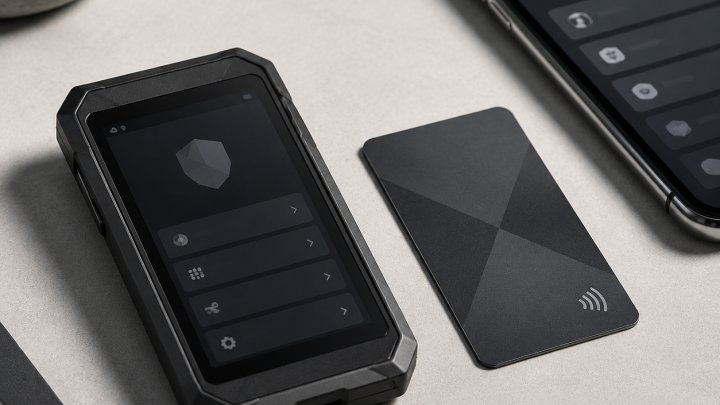
ELLIPAL Titan 2.0 vs Tangem Hardware Wallet Line: The Quick Answer
ELLIPAL Titan 2.0 and Tangem Hardware Wallet Line take different approaches to hardware-wallet convenience. In the supplied product data, ELLIPAL Titan 2.0 is an air-gapped touchscreen hardware wallet using QR signing, with no Bluetooth or USB support listed. Tangem Hardware Wallet Line is an NFC-based hardware-wallet line; the supplied wallet data lists NFC signing and Bluetooth support, while the supplied Tangem source pages emphasize phone NFC, no batteries, no cables, and tap-based use.
For security architecture, ELLIPAL Titan 2.0 has the clearer air-gapped profile because QR signing is listed directly in the product data. Tangem has the clearer card-wallet usability profile because Tangem says its wallet can be activated in two minutes and managed with a tap. For ease of use, the better fit depends on whether you prefer scanning QR codes on a dedicated device or tapping an NFC card to a phone.
Evidence Snapshot
This comparison uses the supplied wallet records and the supplied Tangem source materials only. Where the evidence is manufacturer-stated, the article attributes it as such. Where a field is missing, the comparison says so instead of filling the gap.
Key source links used in this article:
- Tangem English source: https://tangem.com/en/
- Tangem German source: https://tangem.com/de/
- Tangem French source: https://tangem.com/fr/
- Tangem Spanish source: https://tangem.com/es/
- ELLIPAL product-data review URL supplied: https://www.trustpilot.com/review/ellipal.com
Full Comparison Table
| Dimension | ELLIPAL Titan 2.0 | Tangem Hardware Wallet Line | What it means |
|---|---|---|---|
| Connection type | Supplied data lists NFC, while signing method is air-gapped QR signing | NFC signing; supplied wallet data also lists Bluetooth support | ELLIPAL’s stated signing workflow centers on QR codes; Tangem’s stated user flow centers on phone NFC tapping |
| Wireless exposure | Bluetooth: false; USB: false; NFC: true in supplied data | NFC: true; Bluetooth: true in supplied wallet data | Tangem’s official source pages emphasize NFC; users should compare current connection behavior on the product page before purchase |
| Secure chip | Samsung Semiconductors certified microchip; EAL6+ | Samsung Semiconductors certified microchip; EAL6+ | Both records list the same broad chip/certification language |
| Screen | Not stated in supplied ELLIPAL data | Not stated in supplied Tangem source capture | This comparison does not infer display specifications |
| Coins supported | Supplied data says “More than 14,100 assets on more than 90 networks” | Tangem says users can manage over 14,100 assets across more than 90 networks | Both entries share broad aggregate support language, but exact coin lists are not supplied here |
| Price | Not supplied | Captured Tangem prices include 2-card set $54.90 and 3-card set $69.90, with other bundles listed | Tangem has captured page prices; ELLIPAL Titan 2.0 price is not supplied in this job context |
| Open source | Supplied ELLIPAL field contains a Tangem app open-source statement, so no ELLIPAL open-source conclusion is used | Tangem says its app is open source and code can be checked on GitHub | Do not treat this as proof that all firmware, hardware, or chip code is open source |
| Battery | Not stated in supplied ELLIPAL data | Tangem says no batteries, cables, or charging are required | Tangem has clearer supplied evidence on battery-free operation |
| Setup difficulty | Beginner fit 4/5; senior fit 3/5 in supplied data | Beginner fit 4/5; card-wallet fit 5/5 in supplied data; Tangem says activation can take 2 minutes | Tangem has stronger supplied evidence for quick tap-based onboarding |
| Security record | Supplied ELLIPAL record says firmware reviewed independently by Kudelski Security and Riscure | Tangem says firmware has been independently reviewed by Kudelski Security and Riscure; Tangem also claims zero cards hacked out of 6,000,000 since 2017 | Tangem’s zero-hack statement is a manufacturer claim from its source pages, not a guarantee of future security |
Security Showdown
The biggest architectural difference is the signing path. ELLIPAL Titan 2.0 is described in the supplied wallet data as an “air-gapped touchscreen hardware wallet” with “air-gapped QR signing.” In plain English, an air-gapped workflow tries to keep transaction signing separated from direct cable or radio connections. Instead of plugging the wallet into a computer or pairing it like a normal wireless accessory, the user typically moves transaction data through visual QR codes. The supplied ELLIPAL data also lists Bluetooth support as false and USB support as false.
Tangem Hardware Wallet Line is described as an NFC signing wallet. Tangem’s supplied source pages say the hardware wallet is powered by a phone’s NFC module and that tapping the card to a phone is enough to sign transactions or change wallet settings. Tangem also says the product has no batteries, no cables, and nothing to charge. That is a very different security-usability tradeoff: rather than using a separate screen-and-QR routine, the card relies on proximity-based interaction with a phone.
The secure-chip evidence looks similar at a high level. The supplied ELLIPAL Titan 2.0 record lists a Samsung Semiconductors certified microchip and EAL6+. Tangem’s source pages say every Tangem Wallet contains a certified microchip developed with Samsung Semiconductors and that the chip is EAL6+ certified with protection against invasive and non-invasive attacks. Those are useful data points, but they should not be stretched into “unhackable” language. Certification and review claims describe design and assurance signals; they do not remove all risk from phishing, malicious approvals, recovery mistakes, supply-chain issues, or future vulnerabilities.
For security record, Tangem’s official pages claim “Zero out of 6,000,000 cards hacked since launch in 2017.” This can be quoted as Tangem’s claim, but it should not be treated as an independent proof that no Tangem device can ever be compromised. The supplied Tangem materials also say firmware has been independently reviewed by Kudelski Security and Riscure. The supplied ELLIPAL data likewise states that firmware was reviewed independently by Kudelski Security and Riscure, but no separate ELLIPAL source material summary is included in this job context.
Air-Gapped QR vs NFC in Plain English
Air-gapped QR signing and NFC signing are not just marketing labels; they change the daily workflow.
With ELLIPAL Titan 2.0, the supplied data points to QR signing. A QR workflow usually means the phone app and hardware wallet pass transaction information visually. The phone prepares an unsigned transaction, the wallet scans or displays QR codes, and the signed transaction returns to the phone for broadcast. The security appeal is that the wallet does not need to be plugged in by USB or paired by Bluetooth according to the supplied ELLIPAL fields. The tradeoff is friction: scanning codes can feel slower than tapping a card.
With Tangem, the supplied sources emphasize NFC. NFC is a short-range communication method used by many phones and cards. Tangem says its hardware wallet is powered by the phone’s NFC module and can be managed with a tap. The convenience appeal is obvious: there is no cable routine and, according to Tangem, no battery to charge. The tradeoff is that the user depends heavily on a phone-based app experience and a tap-to-sign habit.
Neither design is automatically best for everyone. If your main concern is minimizing direct electronic connections during signing, ELLIPAL’s QR-based model is the clearer fit in the supplied data. If your main concern is reducing setup steps and avoiding charging or cable management, Tangem has stronger supplied evidence.
Ease of Use
Tangem has the more detailed supplied usability evidence. Its official source pages say the wallet can be activated in two minutes and managed with a tap. The same materials say users can sign transactions or change wallet settings by tapping the card to a phone. Tangem also says backups replace the traditional 12-word recovery seed, while a seed phrase remains optional for advanced users. That positions Tangem as a low-friction card wallet for people who want a compact physical key rather than a larger device workflow.
The supplied product data gives Tangem a beginner fit of 4/5 and a card-wallet fit of 5/5. Those fit scores line up with the NFC card design: it is meant to feel familiar to people who already understand tapping a card or phone. Tangem’s no-battery claim also reduces a common hardware-wallet annoyance. There is no charging cable to find and no battery-health concern in the supplied source descriptions.
ELLIPAL Titan 2.0 has a different usability profile. The supplied data gives it a beginner fit of 4/5, senior fit of 3/5, and large-portfolio fit of 5/5. That suggests a device aimed at users who may accept more deliberate transaction steps in exchange for QR-based separation. QR signing can be reassuring because the process is visible and intentional, but it can also add repeated scanning steps. Users who transact often may notice that friction more than users who mostly hold long term.
For daily use, the choice comes down to what kind of friction you prefer. ELLIPAL’s friction is the QR workflow. Tangem’s friction is phone-NFC dependence. Both are manageable, but they suit different habits.
Asset Support and Compatibility
The supplied data gives both products broad aggregate asset language, but with different levels of detail in feature flags.
For ELLIPAL Titan 2.0, the supplied record lists “More than 14,100 assets on more than 90 networks.” It also marks Bitcoin support, XRP support, Solana support, EVM support, WalletConnect support, NFT support, and staking/swap support as true. That makes ELLIPAL Titan 2.0 look more fully described for multi-chain users within this job context.
For Tangem Hardware Wallet Line, the supplied Tangem source pages say users can manage over 14,100 assets across more than 90 networks. Tangem’s source pages also describe storing, buying, earning, sending, swapping, and spending tokens. However, the supplied Tangem wallet-product record marks Bitcoin, XRP, Solana, EVM, WalletConnect, NFT, and staking/swap support as false. Because the source pages provide aggregate support rather than a complete supported-asset list, this article avoids claiming exact token-by-token compatibility.
Price vs Value
The price comparison is uneven because ELLIPAL Titan 2.0 pricing is not supplied in the job context. That means this article cannot fairly declare which product is cheaper or which has the best price-to-value ratio by current checkout cost.
Tangem does have captured price evidence in the supplied source pages. The English source lists Tangem Wallet 2 Cards set at $54.90 and Tangem Wallet 3 Cards set at $69.90. It also lists Family Pack at $139.80, Tangem Ring at $160.00, and Tangem Pro Kit at $180.00. These prices come from the captured Tangem page text and may vary by region, taxes, duties, shipping, promotions, and time.
Value is not only purchase price. For Tangem, the supplied value case is convenience: NFC tapping, no battery, no charging, and card-style backup behavior. For ELLIPAL Titan 2.0, the supplied value case is security architecture and feature coverage: air-gapped QR signing, no Bluetooth or USB support listed, and broader positive support flags for major assets and Web3 features.
If you want the least expensive option among the supplied price evidence, only Tangem has a captured price in this job context. If you want a dedicated QR-signing device profile, ELLIPAL’s value has to be judged against its current official price, which is not supplied here.
Recovery and Backup Model
Recovery is one of the most important differences, but the supplied evidence is incomplete enough to require careful wording.
ELLIPAL Titan 2.0 is listed with a seed phrase backup. That is a familiar model for many hardware-wallet users. A seed phrase can be compatible with broader self-custody practices, but it also creates a major responsibility: if the phrase is photographed, typed into a phishing site, stored in cloud notes, lost, or exposed, the wallet’s hardware protections may not matter.
Tangem’s supplied source pages say backups replace the traditional 12-word recovery seed, while a seed phrase remains optional for advanced users. The supplied Tangem materials also say multiple cards can act as physical keys, with cards linked for recovery. This can reduce the chance that a user accidentally exposes a recovery phrase online, but it changes the backup mindset. Instead of protecting one written phrase, the user must understand the card-backup set, how many cards exist, where they are stored, and what happens if one is lost.
Neither recovery model is universally better. Seed phrases are portable and widely understood in crypto self-custody. Card backups may feel easier for beginners, but users still need a clear storage plan and a good understanding of what each backup method does.
Who Should Choose ELLIPAL Titan 2.0
ELLIPAL Titan 2.0 is the stronger fit in the supplied evidence for users who want an air-gapped QR-signing workflow. If your priority is avoiding USB and Bluetooth signing paths, the supplied ELLIPAL fields are direct: Bluetooth support is false, USB support is false, air-gapped support is true, and QR signing support is true.
It also fits users managing a broader portfolio, at least according to the supplied product scores and feature flags. The record gives ELLIPAL Titan 2.0 a large-portfolio fit of 5/5 and marks Bitcoin, XRP, Solana, EVM, WalletConnect, NFT, and staking/swap support as true. Those flags make it the more feature-complete entry in this specific comparison dataset.
Choose ELLIPAL Titan 2.0 if you are comfortable with a more deliberate signing process, want a dedicated hardware-wallet device profile, and prefer QR-based transaction confirmation over tap-only card behavior.
Who Should Choose Tangem Hardware Wallet Line
Tangem Hardware Wallet Line is the stronger fit for users who want a card-style wallet experience. Tangem says the wallet can be activated in two minutes, managed with a tap, and powered by the phone’s NFC module. Tangem also says there are no batteries, no cables, and nothing to charge. Those claims make the product line appealing for users who want less device maintenance.
Tangem may also suit people who dislike traditional seed-phrase handling. Tangem says backups replace the traditional 12-word recovery seed, while a seed phrase remains optional for advanced users. That can be attractive for beginners, provided they understand how the card backup model works.
Choose Tangem if you value pocketable card convenience, phone NFC interaction, and a battery-free routine more than QR-based air-gapped signing.
Our Verdict
There is no forced overall winner here. The supplied data points to two different self-custody philosophies.
ELLIPAL Titan 2.0 is the stronger fit for QR-based separation. Its supplied data lists air-gapped support, QR signing, no Bluetooth, and no USB. It also has stronger supplied feature flags for large-portfolio use and named ecosystem capabilities.
Tangem Hardware Wallet Line is the stronger fit for simple card-wallet use. Tangem’s source pages support the NFC tap workflow, no-battery design, two-minute activation claim, broad asset-count claim, and app open-source claim. Tangem also has captured price evidence in the supplied materials, while ELLIPAL Titan 2.0 pricing is not supplied.
| Category | Better fit based on supplied evidence |
|---|---|
| Air-gapped QR signing | ELLIPAL Titan 2.0 |
| Tap-based NFC convenience | Tangem Hardware Wallet Line |
| Battery-free operation evidence | Tangem Hardware Wallet Line |
| Positive major-asset feature flags in supplied wallet record | ELLIPAL Titan 2.0 |
| Captured price evidence | Tangem Hardware Wallet Line |
| Screen comparison | No supported conclusion |
| Overall winner | No overall brand winner declared |
The practical decision is simple: choose the workflow you will use correctly every time. A more secure-feeling device is not helpful if you find it too cumbersome and make backup mistakes. A more convenient card is not helpful if you do not understand the recovery model or transaction-confirmation process.
Frequently Asked Questions
Is ELLIPAL Titan 2.0 more secure than Tangem?
The supplied data supports different security architectures rather than a single overall security winner. ELLIPAL Titan 2.0 has stronger supplied evidence for air-gapped QR signing. Tangem has stronger supplied evidence for NFC card convenience, EAL6+ chip claims, and manufacturer-stated firmware review. Security also depends on user behavior, recovery storage, transaction verification, and phishing avoidance.
Does Tangem have a screen?
The supplied Tangem source captures do not support a screen or display specification. This comparison does not claim that Tangem has a screen or that it lacks one based on those sources.
Which wallet is easier for beginners?
Tangem has stronger supplied evidence for quick onboarding because Tangem says the wallet can be activated in two minutes and managed with a tap. ELLIPAL Titan 2.0 also has a beginner fit score of 4/5 in the supplied data, but QR signing may feel more deliberate than tapping an NFC card.
Which wallet supports more coins?
The supplied data uses broad aggregate language for both products: more than 14,100 assets across more than 90 networks. ELLIPAL Titan 2.0 has more positive feature flags in the supplied wallet record, including Bitcoin, XRP, Solana, EVM, WalletConnect, NFT, and staking/swap support. The exact supported-asset list should be checked against current official compatibility information.
Is Tangem fully open source?
The supplied Tangem source says the app is open source and that its code can be checked on GitHub. The supplied evidence does not support claiming that all Tangem hardware, firmware, secure-element design, or chip code is fully open source.