NFC Hardware Wallets Explained: How Tap-to-Sign Crypto Storage Works
The Quick Answer
An NFC hardware wallet is a crypto wallet device or card that communicates with a phone using near-field communication, the same short-range “tap” idea many people know from contactless payments. The goal is to let you approve wallet actions while keeping the sensitive key-handling process separate from an exchange account or a regular software wallet.
In practice, “NFC hardware wallet” is a category, not a guarantee. You still need to understand who controls the keys, how recovery works, what the manufacturer claims, and which claims come from official marketing rather than independent evidence.
What This Actually Means (No Jargon)
Think of a house key. You can keep the key in your pocket, give it to a building manager, or leave it under the doormat. All three choices may let you get into the house, but they create very different risks.
Crypto wallets work in a similar way. The important “key” is not a metal object; it is the private key or recovery method that proves control over funds on a blockchain. If someone else controls that key, they may be able to move the funds. If you control it but lose your recovery path, you may lock yourself out.
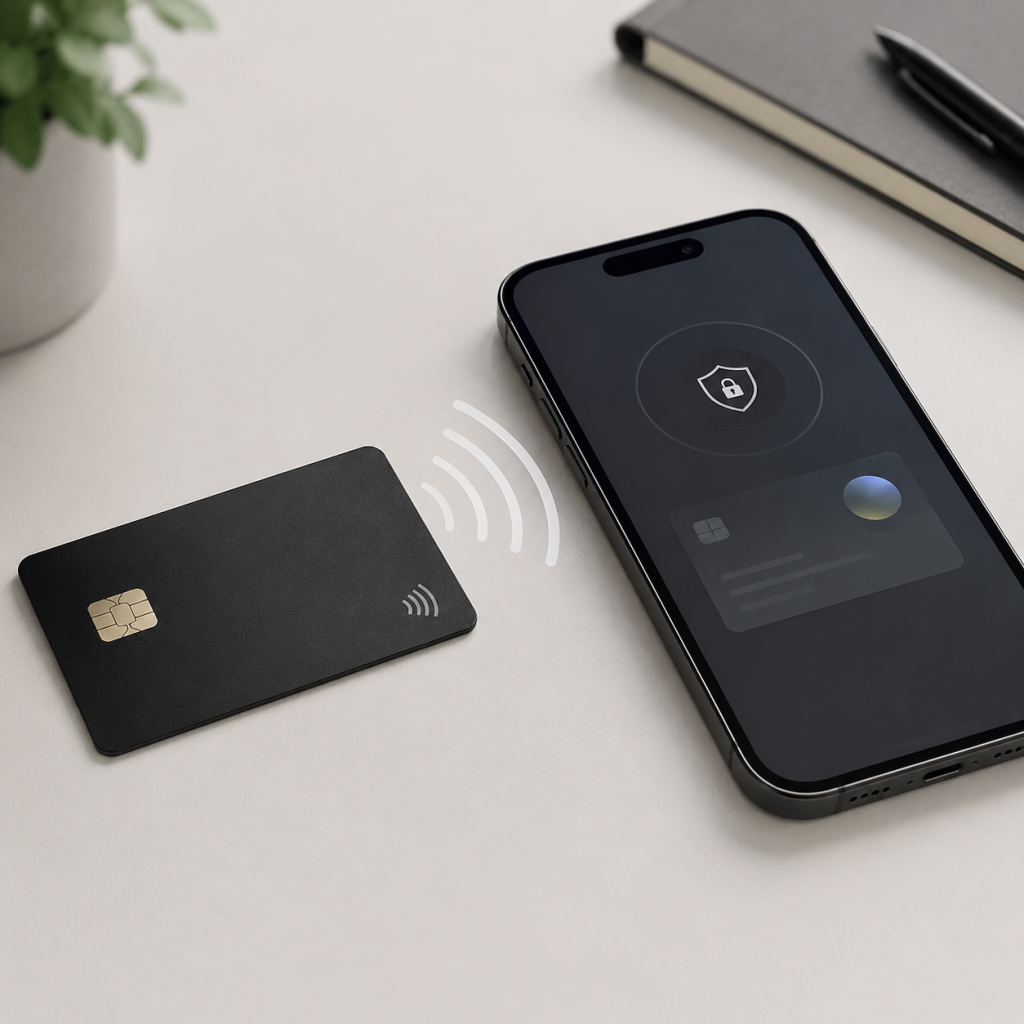
An NFC hardware wallet tries to make self-custody feel more like tapping a card than operating a complicated security device. The wallet card or device communicates with a phone over NFC. The phone provides the app interface and network access; the hardware wallet participates when a sensitive action needs approval.
A useful analogy is a bank safe deposit box. The bank building gives you the lobby, lighting, and counter service, but the box is not supposed to open unless the right key process is used. With an NFC wallet, the phone is the convenient interface, while the hardware card or device is the controlled approval tool.
One supplied example is Tangem Wallet. Tangem describes its wallet as a hardware crypto wallet that keeps cryptocurrency offline and says the hardware wallet is powered by a phone’s NFC module. Tangem also says the wallet can be activated in 2 minutes and managed with a tap, and that its wallet is fully non-custodial. These are manufacturer statements from Tangem’s official pages, not broad claims about every NFC wallet.
Why It Matters for Your Crypto
The central issue is control. When crypto sits on an exchange, the user may have an account balance, but the exchange generally controls the wallet infrastructure. When crypto is held through a non-custodial wallet, the user takes direct responsibility for the key or recovery setup.
That can be empowering, but it is not automatically safer in every practical sense. A person can still approve a bad transaction, lose access to recovery materials, misunderstand which assets are supported, or trust a claim that has not been independently established.
NFC wallets are designed to reduce some everyday friction. There may be no cable to connect and no battery to charge, depending on the specific product. In Tangem’s case, the official pages say its hardware wallet has no batteries, no cables, and is powered by a phone’s NFC module. Tangem also says users can manage more than 14,100 assets across more than 90 networks. That support statement is an aggregate manufacturer claim; it should not be treated as a complete compatibility list for a particular coin, token, region, or app version.
Security language also deserves careful reading. Tangem says every Tangem Wallet contains a certified microchip developed with Samsung Semiconductors, and states that the chip is EAL6+ certified with protection against invasive and non-invasive attacks. Tangem also says its firmware has been independently reviewed by Kudelski Security and Riscure. Those claims are meaningful to evaluate, but they do not mean any wallet is impossible to compromise, that every risk is eliminated, or that a user can ignore transaction hygiene.
The supplied 2025–2026-relevant statistic is Tangem’s own current manufacturer claim that it has “zero out of 6,000,000 cards hacked since launch in 2017.” That statement should be understood as an official Tangem claim from its product pages, not as independently verified proof that no Tangem device can ever be hacked.
The Common Misconception
Many people think an NFC hardware wallet is secure simply because it is a physical card or because it works offline.
In fact, a physical form factor is only one part of the security model. What matters is how keys are generated, how transaction approval works, how recovery is handled, how the app behaves, and what evidence supports the manufacturer’s claims.
The misconception exists because hardware wallets are often described with simple phrases: “cold wallet,” “offline,” “secure chip,” or “tap to sign.” Those phrases are useful shorthand, but they can hide important differences. One NFC wallet may rely on a seed phrase. Another may use card-based backups. One may publish app code. Another may not. A source may describe an app as open source without saying that the hardware, firmware, or chip design is fully open source.
Tangem’s supplied official pages are a good example of why wording matters. Tangem says backups replace the traditional 12-word recovery seed, while a seed phrase remains optional for advanced users. Tangem also says its app is open source and code can be checked on GitHub. That does not, by itself, support a claim that all Tangem hardware, firmware, or secure-element code is fully open source.
How It Works: The Technical Part, Simplified
Here is the simplified flow for an NFC hardware wallet transaction:
- You open the mobile wallet app. The app shows balances, networks, and transaction options. The phone usually provides internet access and the screen interface.
- You prepare an action. This could be sending crypto, swapping through an integrated provider, staking where supported, or changing wallet settings. The exact options depend on the wallet and app.
- The app asks the hardware wallet to approve. With an NFC wallet, that request is passed through short-range tap communication between the phone and the card or device.
- The hardware wallet participates in signing. In plain English, signing means proving that the wallet owner approved a transaction without simply handing over the private key to the internet.
- The phone broadcasts the result. After approval, the app can send the transaction to the relevant blockchain network.
- Recovery remains the long-term safety net. If the phone is lost, the app can often be reinstalled. If the hardware wallet or recovery path is lost, the situation is more serious.
Tangem describes a card-based recovery approach in which backups replace the traditional 12-word recovery seed, while a seed phrase remains optional for advanced users. Other hardware wallet categories may use different recovery models, so readers should not assume that all NFC wallets work the same way.
What You Should Do With This Information
Use the NFC hardware wallet idea as a checklist, not a shortcut.
Before relying on any NFC wallet, ask:
- Who controls the keys: you, a company, or an exchange?
- What exactly happens if the phone is lost?
- What exactly happens if the wallet card or device is lost?
- Is recovery based on cards, a seed phrase, or both?
- Which assets and networks are supported today for the specific wallet app version?
- Are security claims official manufacturer statements, independent reviews, or both?
- Does “open source” refer to the app only, or to more of the stack?
For Tangem specifically, the supplied official materials support cautious statements that Tangem describes the wallet as non-custodial, NFC-powered, battery-free, and backed by card-based recovery with an optional seed phrase for advanced users. The same materials support saying Tangem claims more than 14,100 assets across more than 90 networks, a Samsung Semiconductors microchip, EAL6+ certification, firmware review by Kudelski Security and Riscure, and a 25-year limited hardware warranty.
Those are useful facts to compare against your needs, but they are not a substitute for checking current documentation, supported-asset lists, regional availability, and recovery instructions before moving funds.
Frequently Asked Questions
What is an NFC hardware wallet?
An NFC hardware wallet is a crypto wallet device or card that communicates with a phone through near-field communication. It is typically used so the phone can provide the app interface while the hardware wallet participates in approving sensitive wallet actions.
Does NFC mean the wallet is always online?
Not necessarily. NFC is the short-range communication method between the phone and wallet. The phone may be online, but the wallet’s security model depends on how the device handles keys, signing, and recovery.
Is a tap-to-sign wallet safer than a seed phrase wallet?
It depends on the design and the user. Tangem says its backups replace the traditional 12-word recovery seed while a seed phrase remains optional for advanced users, but that is a Tangem-specific manufacturer statement. Any recovery model can fail if the user does not understand how to restore access.
Can an NFC hardware wallet be considered unhackable?
No wallet should be treated as unhackable. Tangem claims zero hacked cards out of 6,000,000 since launch in 2017, but the supplied source treats that as a manufacturer claim, not independent proof that no device can ever be compromised.